
African Austerity in the 1980s: On the Stubbornness of Fiscal Deficits
This article was originally published on ‘Small Ideas in Economic History’. It offers some in-the-weeds reflections on fiscal policy in Africa during the structural adjustment era (1980s-90s) in the context of my larger research project ‘Africa’s Long Depression’. This project charts an economic history of Sub-Saharan Africa’s growth collapse between the late 1970s and 1990s.
I am currently burrowing through dozens of IMF and World Bank reports from Africa from the 1980s and 1990s, the era of falling incomes per capita and structural adjustment, in an effort to understand how Ministries of Finance responded when their export earnings collapsed and government revenue plunged.
One point that has always puzzled me is how to explain the propensity to run large fiscal deficits, financed in large part from domestic sources. The domestically financed deficit in Tanzania and Zambia, for instance, stood above 5% of GDP by the early 1980s. A common claim in the SAP critiques is that the IMF and World Bank forced austerity onto developing countries, in so doing, decimated basic service provision. But barring willingness by foreign creditors and donors to extend further loans or grants, expenditure cuts quickly become unavoidable. Running a domestically financed fiscal deficit was essentially a way of cutting public expenditure in all but name. Which begs the question, why was this clearly suboptimal fiscal approach so often practiced?
If we take the availability of external financing as exogenous, and assume the governments were borrowing about as much as foreign creditors were willing to lend (in my view a fair simplification), then governments had three options when faced with a shortfall in revenue: they could cut expenditure - and in practice they often did; they could raise taxes - which is harder than it sounds, particularly in the midst of an economic crisis; or they could borrow domestically to finance a growing budget deficit – also very common, to the chagrin of the IMF.
Domestic financing could come from a variety of sources: private banks, the central bank, pension pots and social security funds, or by running up payment arrears. In practice, governments of the 1980s tended to practice what economists call financial repression, they used legal means to force lenders to buy treasury bills at below the market interest rate, through bank reserve requirements for instance, or requiring pension funds to hold a share of their investments in government paper and so on. They also often borrowed ‘illegally’, by not meeting their payment obligations, i.e. running up arrears, including at times to their own employees who might simply not get paid for a few months.
Pitfalls of domestic deficit financing
Such financing strategies might have some merit as one-off solutions to a time-bound crisis, but very soon become self-defeating. Monetisation of the deficit (essentially printing more money), will often fan inflation, which simply cuts the budget through the back door - salaries stay constant in nominal terms but fall in real terms. Borrowing from the private sector crowds out private sector borrowers, or results in money creation (if not properly sterilised), which again pushes up inflation. Borrowing from pension funds at low or negative real interest rates is basically a way of chipping away at the compensation package of (usually public sector) employees. Arrears are arguably the most damaging. When the state stops paying its suppliers, these suppliers in turn struggle to repay bank credits or pay their wage bills, which risk financial instability and further demand contraction. In practice, suppliers start costing in payment delays into their pricing, which means the state pays more for the same goods and services in the future. Arrears on wages, meanwhile, is possibly the least considerate way of trimming the budget through opaque means.
So why do it? Why not bite the bullet and cut spending, rather than doing so covertly through inflation, arrears or pension fund plunder? There are both political economy and behavioural models that offer some plausible explanations. Interest groups pushing for retained or rising budget allocations and wages, were better organised than those who suffered the consequences of inflation or non-payment, as these costs to the economy that are more diffuse and harder to lobby around. To lean on the concepts developed by Hirschman, many of those harmed by these choices may have chosen exit over voice - they retreated from the market or the country, rather than lobbying for change. Psychology probably matters too. Humans are prone to optimism bias, and future revenue projections were typically far too rosy. One can also read deficit spending as a form of extreme short-termism: governments are fighting to survive the immediate political battle, praying for some respite in the year to come, rather than planning for a long war.
There are merits to many of these ideas, but I think the somewhat underappreciated dimension to this all is that many governments did periodically cut expenditure and reduce domestic borrowing, and often by a lot. Many countries in Africa undertook more than one round of major austerity reforms between the early 1980s and late 1990s. In Tanzania public expenditure fell by about 10 percentage points of GDP in the course of the 1980s, in Kenya it fell by more than quarter between 1993 and 1999, while Zambia’s public expenditure yoyoed, rising and then falling considerably in 1983, 1987, 1990, 1992 and 1995. Periodically, domestic borrowing fell below zero, as governments repaid some domestic debt.
The mystery isn’t why countries failed to rein in expenditure - in the short term they proved able to do so - but why this fiscal discipline so often unravelled again within a few years.
My reading is this. Improved fiscal discipline might have been better than the alternative (uncontrolled, chaotic fiscal adjustment), but wasn’t enough to turn around the economy, as it didn’t solve the underlying growth problems. Many poor countries in the 1980s had exhausted their buffers. When the post-reform recovery was tepid, the next set of shocks threw the plan off course again. Permanent austerity, cut upon cut upon cut, delegitimises the reform, and makes it politically harder to sell the second or third time around. The public start smelling rats, and assume that cuts are a consequence of corruption, not global economic turmoil. Governments turn to short-term salves in the hope of riding out the current year’s fiscal crisis.
Tanzania as case study
Tanzania was hard hit by the global shocks of the late 1970s, compounded by some rather disastrous economic policies, and GDP per capita fell by 17% between the late 1970s and mid-1980s, while revenue contracted sharply.
Julius Nyerere stepped down from office in 1985 (partly in recognition that his economic policies were failing) and handed power to Ali Hassan Mwinyi, who signed onto a new IMF programme and an austerity drive. Over the following years, the government’s spending contracted by roughly 5 percentage points, the currency devalued by over 60% and other reforms taken to restore incentives for cash crop producers. But these reform efforts were just not enough to steady the macroeconomic ship; inflation fell modestly but still ran at well above 20%.
In 1992/3 the fiscal deficit shot up once more, as the government failed to meet its revenue targets (in part due to an IMF-supported revenue reform that wasn’t yet yielding enough new revenue to offset tax cuts). This was compounded by a drought in 1993, a large amortization payment falling due to the Paris Club, and a continued decline in the terms of trade. Domestic borrowing increased to fill the fiscal hole, inflation spiked, and the economy contracted.
After another election in 1995, the government pursued another fiscal consolidation, domestic borrowing was reduced sharply again, but this time the government managed to stick with fiscal discipline. Increases in foreign aid prevented expenditure levels from falling much lower and steadied expenditure even in the face of smaller shocks (such as the El Nino floods in 1997/8), and imports per capita began to increase again from around 1998. From 2000 and onward, this cautious recovery was bolstered by strong export growth, mostly thanks to the opening of a gold mine. Exports, imports, GDP growth and revenue growth surged thereafter and Tanzania was out of the woods.
Figure 1-3: Tanzania: Key Macroeconomic Variables
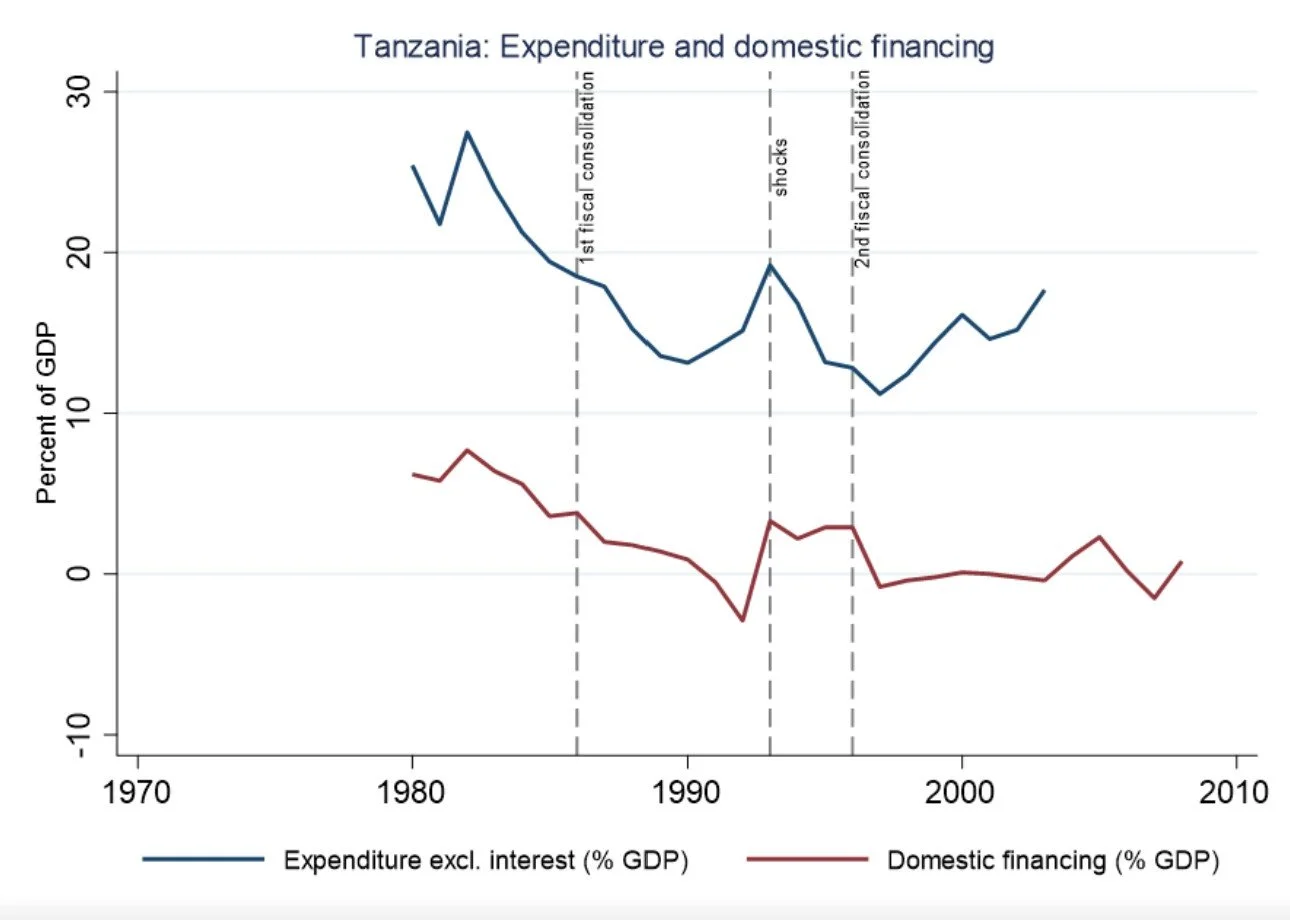
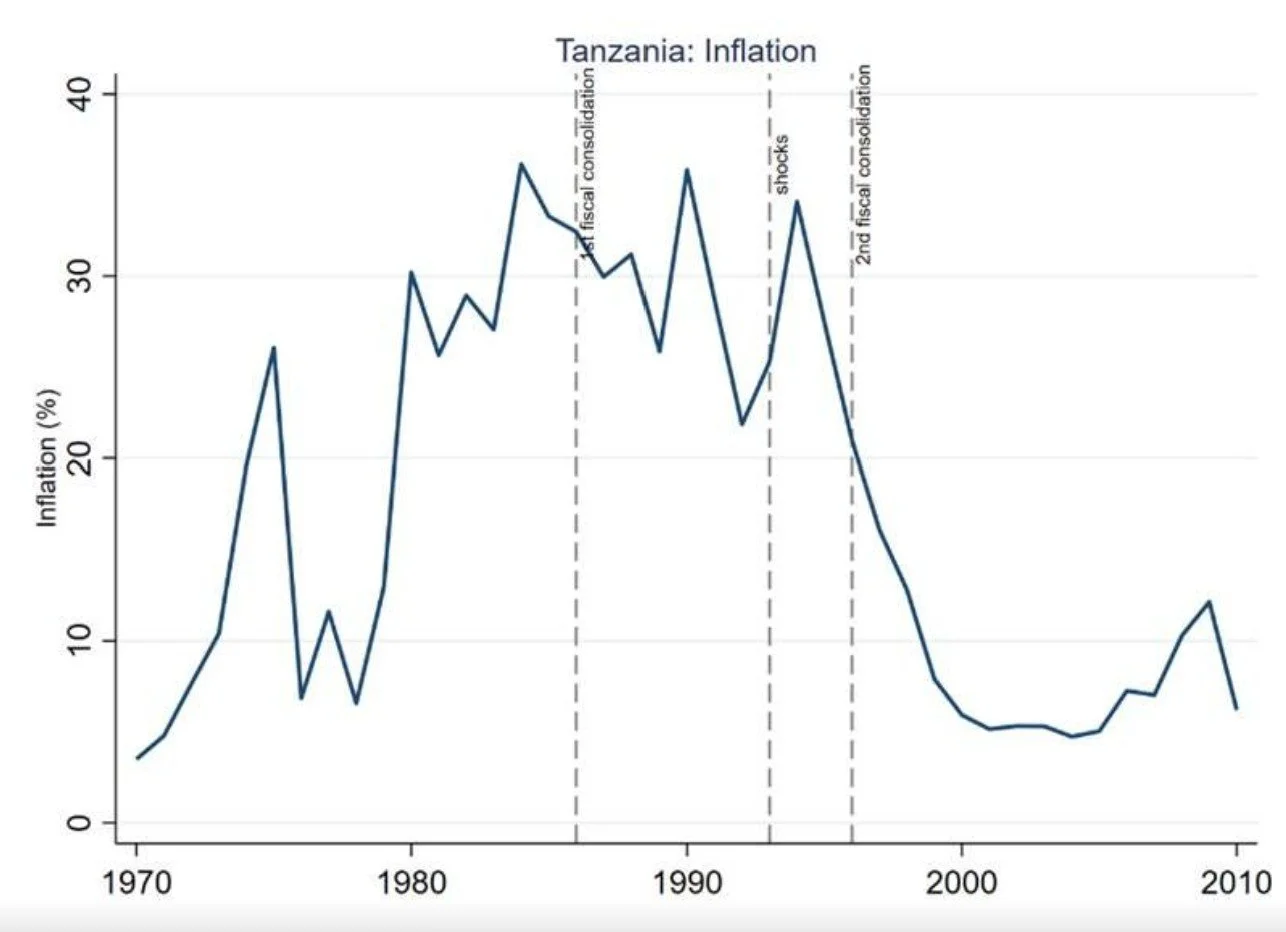
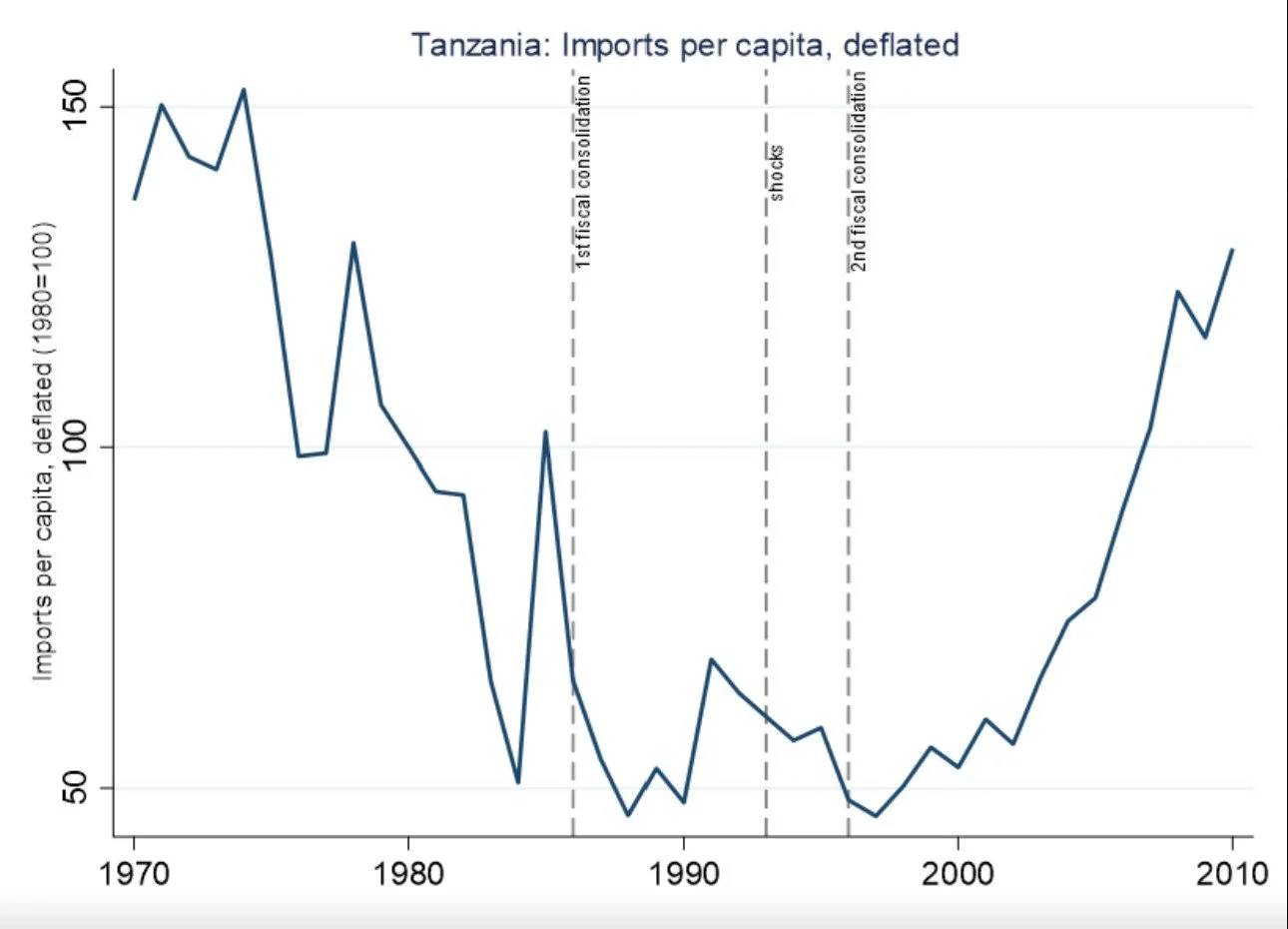
Sources: IMF reports (author’s digitisation and construction), and World Development Indicators.
Growth a precondition for macroeconomic stabilisation?
The perhaps (obvious?) lesson is that it is extremely hard to maintain a balanced budget for more than a few years, without robust economic growth to ensure that the overall pie is growing. Furthermore, macroeconomic stabilisation is not a sufficient condition for restoring growth – particularly when global shocks continue.
This bears on debates about the legacies of structural adjustment (or at least the macroeconomic stabilisation dimensions of SAPs, I’m leaving structural reforms aside here). Some papers have argued that structural adjustment paid off in the longer run, or when govts finally saw the light in the 1990s (see here and here). Another reading is that stabilisation remained elusive until economic prospects brightened, for mostly exogenous reasons, such as rising commodity prices and low global interest rates.
For anyone following the British fiscal dramas of the last few years, this may all have a familiar ring. Relative to Tanzania in the 1980s, Britain has a lot more levers to pull, but as the bond markets have shown, there are limits to the size of the deficit the government can run before the costs start outweighing even hypothetical benefits.
