
When official creditors lend to governments in private debt distress: lessons from African history
IMF Recent Economic Developments: Cote d’Ivoire, 1986, p.56b
This article is cross-posted from Small Ideas in Economic History
In the 2000s countries including Kenya, Ghana, Mozambique, Zambia, Ethiopia, Senegal and Congo accessed the Eurobond market for the first time, contracting debt with private creditors on relatively hard repayment terms. Repayment of these bonds and other non-concessional loans is contributing to Africa’s ongoing debt convulsions.
One solution that has been floated is to replace private with official creditors, who would lend on softer terms. Spain has proposed a trust fund that would extend concessional loans to African governments to finance the buyback of bonds trading at a discount on secondary markets (supported in the Jubilee Report). The earlier Bridge Proposal argued for new multilateral lending to countries with manageable debt stocks but short-term debt service difficulties, on condition that private creditors remain patient and agree to extend the repayment schedules. The Bridge Proposal also points out that in practice, official lending is already ‘leaking out’, as recipient countries use net inflows of credit from international financial institutions to repay debt to private creditors (and China).
The aim of these variations on a theme is to stave off a default, typically a bad thing for all involved (except perhaps the lawyers). I also think an underlying assumption is that the IMF, World Bank and other collaborating creditors have more sticks and carrots than bondholders, and can therefore ensure sound investment of new inflows and thereby improve the conditions for repayment (hear the loud echoes of structural adjustment here).
The argument against such proposals is that if the going gets worse and the sovereign borrower defaults on its concessional loans too, the taxpayer funds that ultimately finance the international financial institutions will in effect have bailed out the private creditors who made the bad investments, then got out early.
Is there anything to learn from Sub-Saharan Africa’s last major debt crisis, which started around 1980, and rapidly engulfed most of the region? Did official creditors effectively take over the debt issued by private creditors, and to what effect?
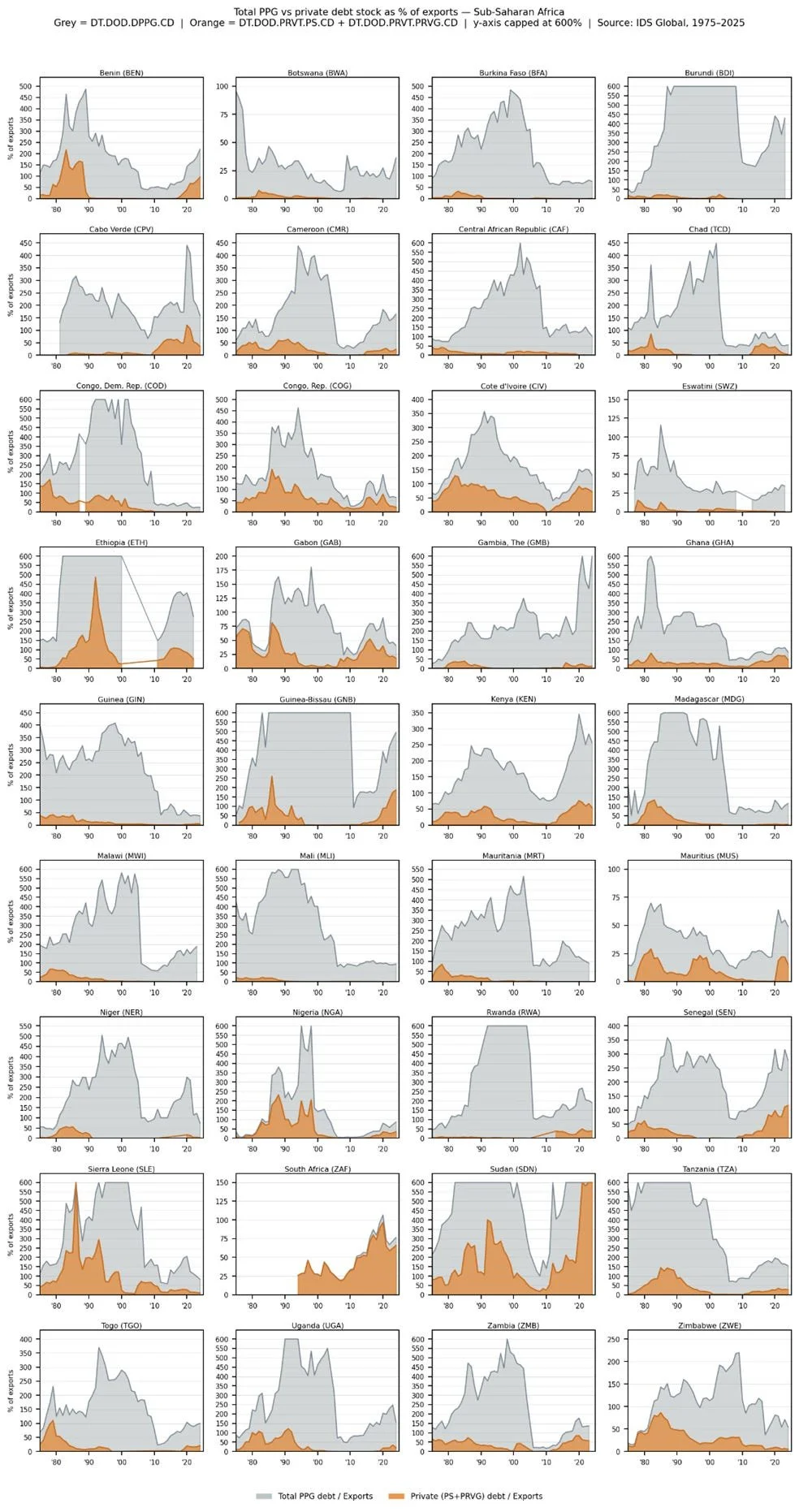
I have gone back to the World Bank African debt data from 1975 and onwards. Some basic descriptives first about the relative weight of private creditors. Figure 1 shows the total external public and publicly guaranteed debt stock, showing that owed to official creditors in grey and that owed to private creditors only in orange, by country. It covers all countries in Sub-Saharan Africa for which the debt data is reasonably complete.[1] I focus on debt stock to export earnings rather than GDP. Most countries had fixed exchange rate regimes in the 1970s and much of the 1980s, so the debt stock to GDP measure is sensitive to devaluations, which mechanically drive up the (mostly) foreign-currency-denominated external debt. I have censored the figures at a ratio of debt to exports of 600% to make it possible to see the dynamics at the beginning and end of the period, before countries defaulted and debt, on paper, ballooned. Arrears are included in the debt stock. For reference, the current Debt Sustainability Framework (DSA) considers an external (public) debt to export ratio of 140%-180% as its threshold for sustainable debt, depending on the country’s debt-carrying capacity.
Figure 1. Public and public-guaranteed debt stock as % of exports
Source: IDS Global
In most countries, the debt owed in the 1980s was mostly to official, rather than private creditors. This is true today too. Like today, the countries where the debt crisis erupted earliest tended to be those with large debts owed to private creditors, which carried higher interest rates and shorter grace periods and repayment periods, relative to the mostly concessional borrowing from official creditors.
A few of Africa’s richer countries had market access already in the 1970s, and private credit comprised a bigger share of the total in Côte d’Ivoire, Nigeria, Kenya, Senegal, Togo and Zambia, and earlier in the 1970s, Zaire (DRC). In these countries, the composition of debt shifted from private to official creditors over the course of the 1980s, as countries lost market access while official creditors continued lending to countries in debt distress or outright default. To what extent did official creditors bail out the private ones – in effect taking over the private debt, by lending funds that countries used to repay the banks? Did this bring debt down to sustainable levels and avert defaults? Or should we think of this as moral hazard, private creditors lent indiscriminately on the assumption that the borrower would be bailed out by the international financial system?
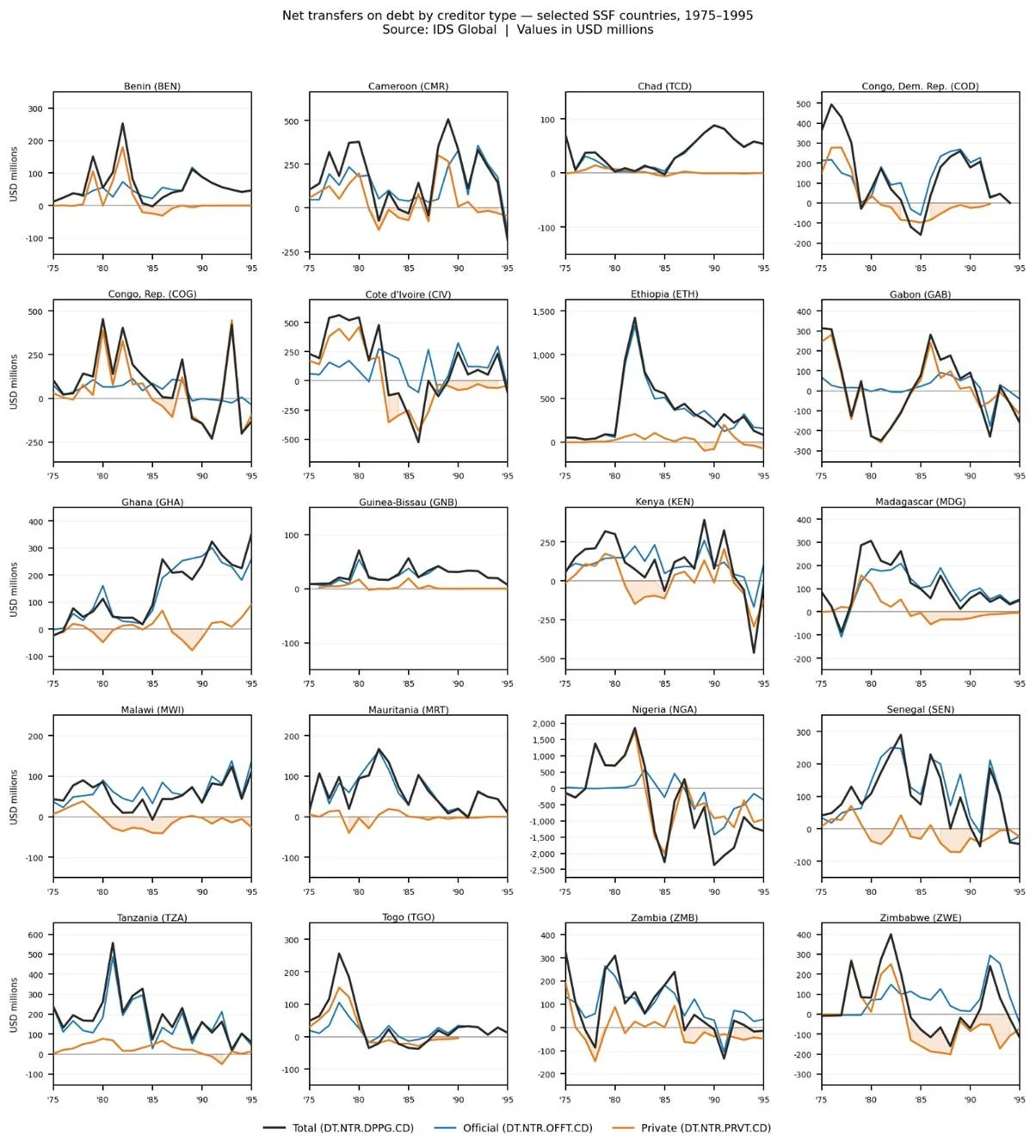
To examine this, Figure 2 looks at the flows on debt from different creditor types, building on the assumption that foreign exchange inflows are fully fungible. In practice, of course, these funds are not fully fungible – some loans will be earmarked for very specific project purposes, such as a road or a factory, and in practice don’t free up the full disbursement amount for debt service. But having new debt disbursements flowing in certainly eases the repayment of past debt (and may raise the cost of a default, if the default were to scare off current creditors).
Figure 2 is not the easiest to read, but it’s the best way I can think of to illustrate these dynamics. The lines measure the net transfer on debt, i.e., the total amount of new debt disbursements coming in, minus the total actual repayments; think of it as the actual forex flowing in or out. If this number is above zero, the country is receiving more in new inflows than it is repaying, and vice versa. We can look at this separately for official and private creditors, as well as for total debt. When the private net transfers turn negative, while the official net transfers remain positive, we can think of official debt disbursements as offsetting the private outflows and indirectly helping to finance these repayments. The shaded orange areas thus illustrate how much of the private debt repayments were hypothetically financed by positive net official debt inflows.
Figure 2. Net transfers on PPG debt by creditor
Source: IDS Global
Note: countries with negligible private creditor debt or missing data excluded.
What do these figures show? During the 1980s debt crisis, net outflows on debt to private creditors were in practice quite small, in most years above or close to zero. The implicit repayment of private creditors using borrowing from official creditors (the orange areas) was not enormous. In some cases, this is because countries defaulted early on their private debt, while official creditors continued to lend. In other cases, private debt was small to begin with. The unusual case of Nigeria, which does make sizable repayments, reflects the fact that its debt transfers remained small relative to its sizable oil revenue.
There are exceptions, however. Kenya and Malawi in the early 1980s, and Senegal and Zimbabwe in the late 1980s/90s made meaningful debt repayments that were indirectly financed by official creditors. The cumulative debt ‘conversion’, private repayments that were fully compensated for by official inflows, was US$610m in Kenya, US$290m in Malawi and US$400m in Senegal (nominal terms), more than the total stock of private debt in 1985.
We can look at two cases more carefully to consider how debt to private creditors was managed, by comparing Côte d’Ivoire, where the private debt burden was particularly high and which defaulted on this debt relatively early, and Kenya, which largely repaid its private and official creditors.
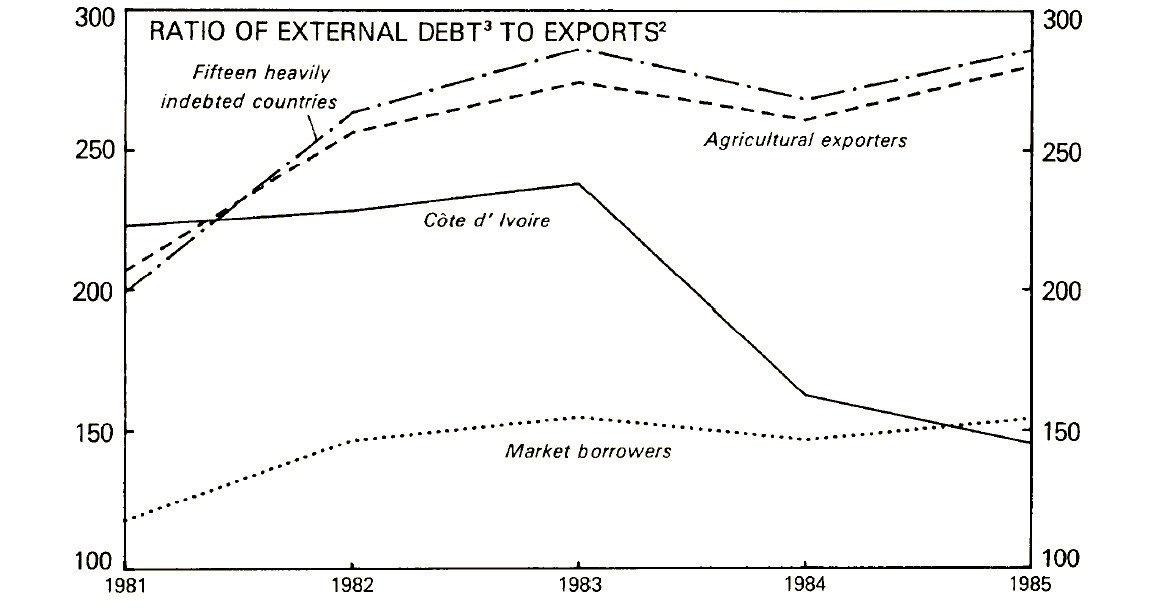
Côte d’Ivoire faced a first phase of debt strain between 1978-1983. Its main export crops, cocoa and coffee, had shot up in price between 1975-77 – the country invested much of this windfall AND took on considerable debt to finance big infrastructural investment – hydroelectric schemes, harbours, oil refinery expansion, road and rail – and an ambitious ISI strategy built around agro-industry. The debt profile worsened towards the end of the 1970s, and by 1980 Côte d’Ivoire was paying an interest rate of 12.3% on newly committed loans, mostly with maturities of 5-12 years.
Cocoa and coffee prices plummeted between 1980 and 1983, and Côte d’Ivoire faced an unmanageable debt service ratio of 42% of exports in 1983 before rescheduling. It began accumulating large debt arrears. It reached agreement with the Paris and London Clubs in 1984-5 (as well as a separate creditor group called the Abidjan Club), and rescheduled the vast majority of principal repayments, which kicked the can down the road. Export prices recovered slightly in 1983-5 bringing the debt to export ratio down to (arguably) manageable levels, only to fall even further thereafter. In 1987, Côte d’Ivoire suspended all payments on commercial bank and other private loans.
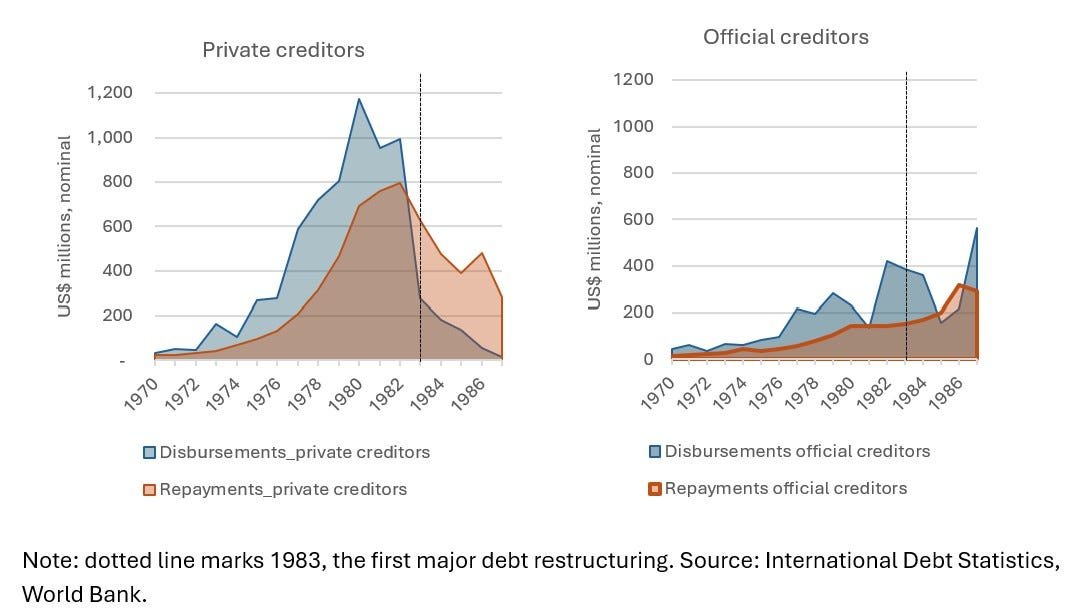
How much did Côte d’Ivoire actually repay in this period? Did an increase in lending by official creditors in this period of growing debt distress prevent an earlier default? Disbursements on fresh private-sector debt in fact exceeded debt service on private debt until 1982, in most years by relatively healthy amounts.[2] Figures compare the total amount, in nominal US$, that Côte d’Ivoire received in disbursements and repaid, by creditor type. Between 1983-87, in contrast, the government repaid about US$300 million more each year than it received in new disbursements from banks and private lenders, for a cumulative total net outflow on private debt of about US$1.5 bn. In contrast, net transfers on official debt stayed positive in most years and inflows were around US$550 million over the same 1983-87 period. New borrowing from official creditors offset some of these private repayments, particularly in 1983-4, but the effective bailout of private creditors with public funds was not huge. Côte d’Ivoire still held a private debt stock of US$3.4 bn when it defaulted on most of it in 1987.
After 1987, arrears on private debt kept building up. Côte d’Ivoire only resolved its private sector debt in 2010, in parallel with its HIPC process, concluded in 2012.
Figure 3. Côte d’Ivoire: Debt disbursements and repayments 1970-87
Kenya, in contrast, avoided an outright default during the 1980s and 1990s and did not take debt relief under the HIPC programme. It started borrowing on private markets in 1977/8, through supplier’s credit. It then contracted two eurocurrency loans in 1979 and 1981 on hard terms, in response to the balance of payments crunch following the fall in coffee prices and surge in oil prices. The 1981 bank borrowing carried an interest rate of 15.4% and a maturity of 9.2 years, while bilateral debt contracted in the same year carried an interest rate of 3.1%, and multilateral debt one of 6.2%. Kenya reduced its private borrowing after 1981 and remained current on its debt payments through the 1980s, mostly paying off the two eurocurrency loans by the end of the decade.
It began borrowing from the private market on commercial terms again in the late 1980s, worsening its debt position in the 1990s. Kenya began to accumulate arrears between 1991 and 1993, and later reached agreement with the London Club in 1994 to reschedule some of its private debt. By the end of 1994, Kenya had cleared most of its arrears.
Until roughly 1990, debt disbursements by official creditors were growing steadily and remained well in excess of repayments. Between 1981 and 1985, Kenya made repayments on private debt of over US$900 million and on official debt of US$600 million, while new disbursements on official and private loans came to roughly US$1.8 billion. New official inflows more than compensated for the net outflows due to private debt repayments. Kenya was replacing its private creditor debt stock with debt to official creditors. Average interest rates peaked in 1982 at 6.9% and came down to 4.7% by 1988, when repayment of official debt formed a larger share of total repayments.
The debt difficulties in the 1990s arose because net transfers on official debt turned negative for the first time. Some donors suspended balance of payments assistance in 1991, in reaction to the fraught political climate in the run-up to the first multiparty election in 1992. The overall net inflow of capital turned to an outflow, and Kenya began accumulating external payment arrears for the first time in its history. To avoid a default and retain market access, the government made large repayments in 1994 by sharply cutting public spending.
Figure 4. Kenya: Debt disbursements and repayments 1970-99
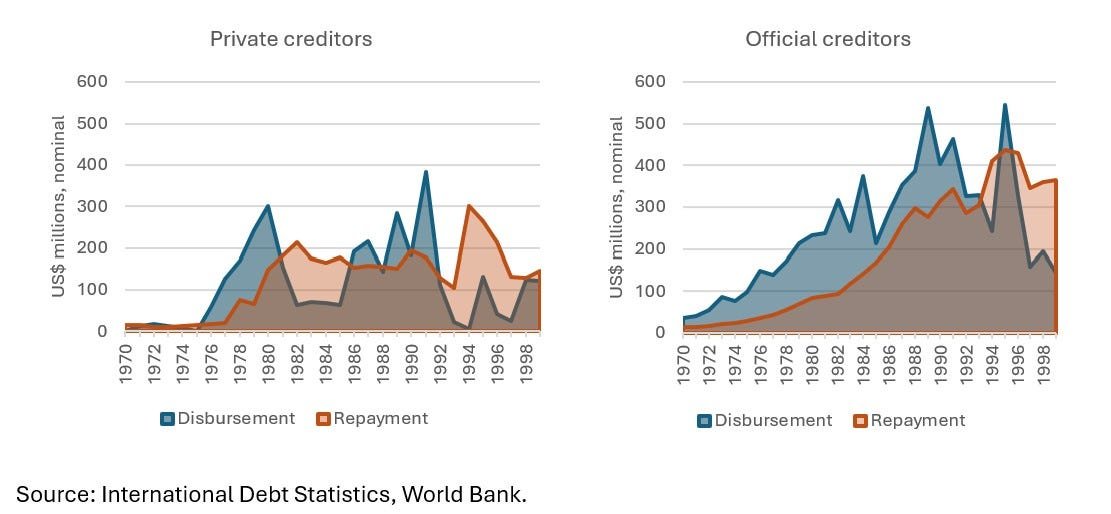
In the Kenyan case, official creditors in practice replaced some private debtholders, Kenya avoided a default, and interest rates came down. Arguably, this indirect external financing of private repayment also enabled Kenya to continue borrowing on commercial terms in the late 1980s (possibly some moral hazard here?), which pushed it very close to default in the 1990s. Ultimately, however, Kenya muddled through and repaid much of its private and official debt. In Côte d’Ivoire, in contrast, official borrowing may have prevented an earlier full default already in 1983/4, but the private debt burden appears to have been too high for official creditors to meaningfully offset.
The moral of the story is that careful debt sustainability assessments are important, but the incoming creditors are nonetheless making a gamble. If a country can muddle through with the help of further concessional financing, improve the repayment terms to ‘sustainable’ levels, avoid a default and grow itself out of its debt burden, this is probably a better alternative to the typically protracted and messy sovereign defaults that haunt many a finance minister. But this is always something of a gamble on the part of the incoming creditors, as any number of unknowns can push the recipient country into default in the future.
In the case of Côte d’Ivoire, balance of payments support in the early 1980s helped to delay the eventual default on both private and official debt by a few years; conditions looked a little rosier when cocoa prices perked up briefly in the mid-1980s. But in the longer run, Côte d’Ivoire defaulted anyway, and official creditors had in effect offset some of the private creditors’ losses at their own expense.
As with the Spanish/Jubilee proposal, it does seem sensible for official creditors to take a portfolio approach, recognising that some of these bets will pay off and others won’t. Either way, it seems very likely that some of these proposed recovery loans will leak out, effectively bailing out the private creditors.
References: This note draws on IMF Recent Economic Development Reports, for Kenya (1986, 1990) and Côte d’Ivoire (1985, 1986 and 1989). Debt data from the International Debt Statistics.
[1] I am taking this data at face value below: there are likely to be some inaccuracies (the IMF repeatedly commented on the incomplete debt data in its 1970s and 1980s reports), but it looks reasonably consistent with contemporary estimates.
[2] This focuses on external debt held by the public sector only. The database does not record much publicly guaranteed debt, which was substantial in Côte d’Ivoire according to contemporaneous IMF reports. The totals suggest that this is probably incorporated into the public-sector debt variables, but it is not quite clear if the dataset is simply missing a proportion of all debt.
