
Book Review: Women in Public Finance
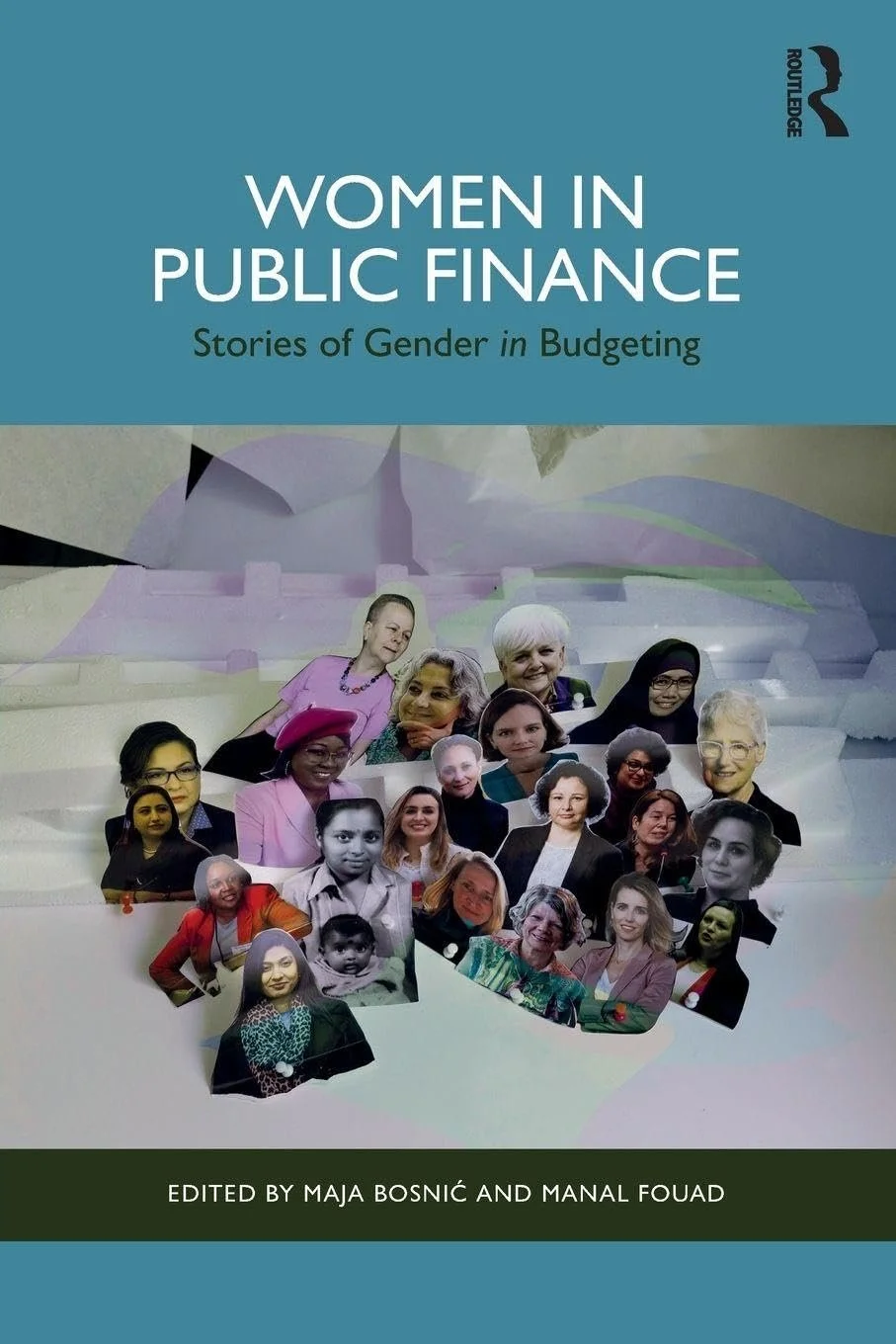
The book was published on August 20
Women in Public Finance[i] is an excellent book. It is an edited volume of 20 chapters that tries to both illuminate the role of women in public finance and discuss the state of gender budgeting. That ambition made this book a bit of a pain to review, but more importantly a joy to read, because most of these twenty contributions are both very interesting and deeply personal and honest. I will try to discuss the two ambitions in turn.
“Public Finance” or “PFM” is not just a subject or a policy area, it is also an epistemic community, that is, a network of experts who share a common set of goals, ideas, and a recognized body of knowledge. In fact, it is probably much more a community of experts than a discipline, since there is no corresponding academic discipline of PFM[ii]. PFM experts can be accountants, jurists, administrators, or economists, and despite some grudges, recognize each other’s membership. This PFM community is both quite small (a few hundred people who work on it globally) and a giant fragmented patchwork (the many thousands of people doing PFM work in countries, many of whom probably wouldn’t recognize the PFM label). Wherever the boundaries are exactly, PFM has coalesced a lot around a shared set of issues and body of knowledge, led by the work of the IMF, the OECD, and the World Bank, among others.
Women in Public Finance is the first book (to my knowledge) that explicitly puts the spotlight on the experts who do global PFM work, their norms, biases, and how their personal perspectives interact with their technical domain. Through the lens of women, obviously, but it is a groundbreaking PFM book in general.
18 of the 20 chapters are first-person accounts written by (or interviews with), well, women in public finance. The authors are mostly experienced, mid-to-late career professionals who have spent at least parts of their careers working internationally. Many have held staff or consulting roles with the IMF, the World Bank, or similar international organizations. They have not, in other words, spent most of their careers in the public spotlight. Most of the chapters don’t read like routine accounts that have been told many times and much more like good friends opening up about their lives over dinner.
It is sobering and unsurprising that experiences of discrimination and dismissal run through the entire book. The stories are sometimes told with subtlety and humor. I had to laugh out loud at Manal Fouad’s account (in Chapter 3) of her, an Egyptian, sitting in a restaurant in Damascus at the start of the Arab Spring, listening to her “Western and very kind colleagues explain to me what is happening in my own country and why the uprising is dangerous for regional stability”. Ouch.
Others are just infuriating. They range from invitations to don traditional dress and perform a folk dance (Chapter 5) to a bilateral donor official asking what’s next after gender budgeting, “animal rights budgeting?” (Chapter 9). No, this is not an episode of Mad Men, this is PFM in the 2010s. And no doubt there are plenty of other such cases, including of women who had their careers stunted or left the profession altogether. For many women, this is what it was like to work towards acceptance in a global PFM community that was long dominated by older white Anglo-Saxon men (the “Boys’ Club”, as the editors call it).
At the same time, the volume is also an account of success, albeit often implicitly. Over the last 20+ years, many authors rose to become pillars of the PFM establishment. Manal Fouad, for seven years the head of one of the IMF’s two PFM divisions, describes hers as a “brilliant team, with great country diversity, and at many times full gender parity” (Chapter 3). By my own count, between 2016 and 2024, the two PFM divisions had an unbroken run of non-white, female division chiefs, and the last white dude departed that role in 2016. It would be surprising if PFM today wasn’t more welcoming of different people and viewpoints than it was a generation ago, thanks to the work that the women in this book did.
One problem of the PFM community that the volume inadvertently highlights is the absence of any good data about itself. Ironic, given the subject. If anyone wanted to discuss the changing composition of top-tier economics faculty or the staff of the UK Treasury, they wouldn’t do it without data. It would be easy to define who is in or out, and much of the information is readily available in the public domain. Because this volume’s framing of PFM as a community of experts is so novel (if painfully overdue), there is no data. We might have a general idea, but no precise notion of who the members of the PFM community are. Even if we took the staff of the PFM/budgeting-related units from the big international organizations as a proxy, that information is not public. In the book, the only data point is a 2023 survey that reports on the underrepresentation of women among finance ministers and central bank governors. Arguably most of them aren’t even PFM professionals to begin with. Somebody should really do something about that.
It should be obvious at this point that Women in Public Finance is not a conventional analysis of gender budgeting. The first-person accounts offer a variety of different perspectives, sometimes detailed, sometimes not, without claiming to be more than a personal perspective. Only towards the end of the volume does Angela O’Hagan’s excellent chapter (No. 19) provide an overview of gender budgeting that both explores its roots in feminist economics and links the authors’ personal accounts to the broader fight for gender equality. Readers who have so far only come across gender budgeting in the technical PFM literature will find much to learn in this chapter.
O’Hagan’s discussion of feminist economics and the link to gender advocacy underscores how gender budgeting found its way into the mainstream of PFM in an unusual way. It started with a strong disciplinary focus in economics and looked towards fiscal policy much more than “PFM”. O’Hagan’s references reflect this trajectory. This gender budgeting is much less wedded to a particular set of tools and standards than other subfields of PFM are. O’Hagan draws an illuminating distinction between gender budgeting (the broader term that grew out of feminist economics) and Gender-Responsive Budgeting (GRB), the term used now in the literature to describe the administrative toolkit used in international practice.
The other chapters do not share a single definition of the scope and precise meaning of gender budgeting or GRB. For some, it seems closely linked to some form of program or performance budgeting. For others, it is essentially whatever analytical or budgetary instrument works to advance gender equality in this or that country. Urška Zrinski, who co-led the drafting of PEFA’s Gender Framework, still talks about her subsequent work in the Caribbean (Chapter 5) in much broader terms: “gender budgeting is not just an analytical exercise”.
This open approach seems right, both practically and analytically. It would have been impossible for the editors to try and impose a precise definition of gender budgeting on such a diverse group of authors. This is obviously not that kind of book, and much better for it. It also seems a good reflection of where gender budgeting currently stands within public finance. Its arrival as a mainstream issue is still relatively recent. Except for some trailblazing countries, gender budgeting reforms are not that old yet. As with all PFM reforms, 10-15 years of implementation is often simply too soon to tell whether a new norm has been institutionalized. At this point, why narrow the scope of the technical debate when productive trial and error seems to yield progress?
It is worth remembering that the rise of gender budgeting coincides with a growing interest in the intersection of PFM and health, and PFM and climate change (among others). What these areas have in common is a base in their domain expertise and activist agenda – they are separate epistemic communities. If we think of them as Ven diagrams, then the area where PFM and gender, health and climate change overlap are called gender budgeting, health financing, and climate finance, respectively. The big win of the last decade has been that all the sets want these overlaps to exist and persist, notwithstanding the sometimes painful efforts at mutual translation and comprehension. The resulting tension ought to be productive and a source of innovation and well worth the occasional sigh of “why won’t they understand”.
If anything, the book understates how much PFM has already changed and how well this is covered in the PFM literature. In public administration, the idea that bureaucrats’ values and concerns shape policy goes back at least to Herbert Simon’s “Administrative Behavior” (1947), via Naomi Caiden and Aaron Wildavsky’s “Planning and Budgeting in Poor Countries” (1974) and plenty of stops along the way. Matt Andrew’s 2013 book on “The Limits of Institutional Reform in Development” sparked an ongoing debate about how to do reforms beyond just drafting “policy”. Future work could use this research and follow the lead of Women in Public Finance to better understand the global PFM community itself.
Which brings us back to the link between gender budgeting and women in public finance. It is surely no coincidence[iii] that the gender balance among PFM officials improved at the same time as the space for gender budgeting grew. “Dilution of focus, special interest pleading”, some might complain, but that is unconvincing. It’s far more likely that a less uniform expert community (not just by gender, also by nationality, culture, language) is better protected against blind spots, groupthink and the assumption that a handful of countries have all the answers. That said, some amount of gatekeeping and insisting on a common set of objectives and knowledge foundations are essential for PFM to function as a community of experts. Where to draw those boundaries now seems like a very useful debate to have.
Maja Bosnic notes (in Chapter 20) that often
“I have heard the question: Why are we calling it gender budgeting? People say, “If you called it social budgeting, everyone would love it more because it would feel less threatening, less political[iv]” That has always struck me, because it reveals a deeper tension: Are we working toward gender equality, or are we working toward gender budgeting?”
Reading this book has convinced me that this tension doesn’t have to be resolved. Gender equality is a legitimate concern for public finance (arguably always has been), and it’s legitimate to continue arguing over the best PFM ways to achieve it.
Women in Public Finance deserves to be read widely. Whether they are just getting started in public finance (or public policy in general) or already well established, readers should find encouragement in these accounts. It would be great if this book sparked more interest and discussion about the people in public finance. There is lots to study and lots to discuss.
[i]Disclaimer: I wasn’t asked to or paid to do this review, but I did request and receive access to an online review copy from the publisher.
[ii] Public finance as distinct from PFM is a bit different, since it is usually understood to be a subfield of economics and very clearly tied to fiscal policy. But that is hair-splitting for another day.
[iii] For the economists reading this, no claim of causality in either direction intended.
[iv] It is a category mistake to think that one kind of budgeting is more or less political than another, anyone who thinks that social budgeting is less political than gender budgeting should urgently consult the Wikipedia entry for the Communist Manifesto.